















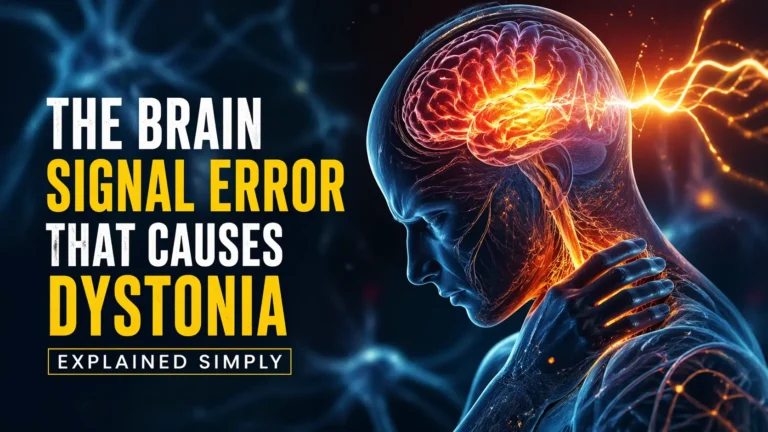
Something feels off long before most people ever hear the word Dystonia. A neck that pulls slightly to one side, a hand that tightens without warning, or a movement that refuses to stay smooth no matter how hard you try to control it. It doesn’t feel like an injury, and it doesn’t behave like one either. The body is responding, but not in the way you expect.
The reason behind this strange behavior is not in the muscles themselves. The real issue begins in the brain, where movement is planned, adjusted, and controlled every second of your life. Dystonia happens when that control system develops a subtle but powerful error.
The Brain’s Job: Sending Clean Signals
Every movement you make is guided by a complex communication system. Your brain sends electrical messages through nerves to tell muscles when to contract and when to relax. This system works so smoothly that you rarely notice it.
A key part of this process is handled by the Basal Ganglia, a group of structures deep inside the brain. Its role is to fine-tune movement, making sure actions are smooth, controlled, and appropriate for the situation.
Think of it as a highly advanced filter. It allows useful movement signals to pass through while blocking unnecessary ones.
When this filter works properly, movement feels natural. When it doesn’t, things begin to change.
The Core Problem: Signals Without Control
Dystonia is not caused by weak muscles or damage to joints. It is caused by a breakdown in how the brain filters movement signals.
Instead of sending clear, precise instructions, the brain begins to send overlapping or excessive signals. Muscles receive commands they shouldn’t be getting, or they keep receiving signals long after they should have stopped.
This creates a situation where:
- Muscles contract at the wrong time
- Opposing muscles activate together
- Movements become twisted, repetitive, or stuck
It is not a strength issue. It is a control issue.
Why the Brain Starts Misfiring
The exact reason this signal error begins is still being studied, but researchers have identified several contributing factors.
Loss of Signal Inhibition
In a healthy brain, unnecessary movements are suppressed automatically. In dystonia, this suppression weakens, allowing extra signals to pass through.
Overactive Movement Circuits
Certain neural pathways become too active, sending more signals than needed. This overwhelms the system.
Faulty Feedback Loop
The brain depends on feedback from the body to adjust movements. In dystonia, this feedback becomes unreliable, so corrections don’t happen properly.
Learned Movement Errors
Over time, the brain can “lock in” incorrect movement patterns, repeating them even when they are not useful.
This is why some forms of dystonia appear only during specific tasks, like writing or speaking.
Why Symptoms Feel Random but Aren’t
Many people describe dystonia as unpredictable. Some days feel manageable, while others feel completely out of control.
What’s actually happening is subtle. The brain’s signal system is unstable, and small changes can influence it.
Things that can increase symptoms include:
- Stress
- Fatigue
- Anxiety
- Repetitive activity
These factors don’t cause dystonia directly, but they increase noise in the brain’s communication system, making the signal error more noticeable.
The Role of Brain Chemistry
Brain signals are not just electrical; they are also chemical. One of the most important chemicals involved in movement control is dopamine.
Dopamine helps regulate how signals are sent and received. When its balance is disrupted, the brain struggles to control movement smoothly.
This is why some treatments focus on adjusting brain chemistry. They aim to stabilize the signaling system, even if they cannot fully correct it.
Different Forms, Same Underlying Issue
Dystonia can affect different parts of the body, but the core problem remains the same.
- Cervical dystonia affects the neck
- Focal dystonia affects a specific area like the hand
- Generalized dystonia affects multiple body regions
Even though the symptoms vary, the root cause is always linked to abnormal brain signaling.
What Triggers the Condition
Dystonia does not always have a single clear cause.
In some cases, genetics play a role. Certain individuals are born with a higher chance of developing the condition.
In other cases, it may be triggered by:
- Physical injury
- Neurological illness
- Long-term repetitive movements
- Unknown factors
Often, it is a combination of vulnerability and trigger that leads to symptoms.
Why It Is Often Misunderstood
Because dystonia does not show up on standard scans in obvious ways, it is frequently misdiagnosed in the early stages.
People are often told it is:
- Muscle tension
- Poor posture
- Stress-related
While these factors can influence symptoms, they do not explain the underlying neurological issue.
Accurate diagnosis usually requires a specialist familiar with movement disorders.
For deeper patient-focused insights,
https://dystoniasupport.com offers real experiences and explanations from those living with the condition.
Can the Brain Adapt and Improve?
One of the most important things to understand is that the brain is capable of change. This ability, known as neuroplasticity, means it can adapt over time.
Certain therapies aim to retrain the brain’s movement patterns, including:
- Physical therapy
- Sensory retraining
- Controlled movement exercises
These approaches do not produce instant results, but they can gradually improve control and reduce symptoms.
Treatment Options That Help Stabilize Signals
While there is no complete cure, several treatments can help manage dystonia effectively.
Botulinum Toxin Injections
These reduce muscle overactivity by weakening specific muscles.
Medications
Some drugs help regulate brain chemicals and reduce abnormal signaling.
Deep Brain Stimulation
A surgical option where controlled electrical signals are sent to targeted brain areas to improve movement control.
For medical reference and research-backed information,
https://www.ninds.nih.gov provides detailed neurological resources.
Living With Dystonia
Understanding dystonia changes how you see it.
It is not your body failing. It is your brain sending mixed instructions.
That distinction matters because it shifts the focus from blame to management. When you understand the source of the problem, you can approach it with more clarity and less frustration.
Many people learn to adapt, finding ways to reduce symptoms and improve daily life, even if the condition does not disappear completely.
Important Disclaimer
This article is for informational purposes only and does not replace professional medical advice. If you notice unusual muscle movements or suspect dystonia, consult a qualified neurologist for proper diagnosis and treatment.
FAQs
What causes dystonia in simple terms?
Dystonia is caused by the brain sending incorrect or excessive signals to muscles, leading to involuntary movements.
Is dystonia a neurological disorder?
Yes, it is a disorder of the nervous system that affects movement control.
Can dystonia go away on its own?
Some mild cases may improve, but many require ongoing management.
Does stress make dystonia worse?
Yes, stress can increase the intensity of symptoms by affecting brain signaling.
Is there a cure for dystonia?
There is no complete cure yet, but treatments can significantly reduce symptoms.
Final Thought
Dystonia is not something you can see clearly from the outside, but inside the brain, the difference is significant. A system designed to create smooth, effortless movement becomes slightly distorted, and that small distortion can have a powerful effect on the body. Understanding that the issue lies in communication, not effort, opens the door to better management, better awareness, and a more informed way forward.


0 Comments