


















There is something deeply frustrating about dystonia that only those living with it truly understand, the feeling that your own body is not fully listening to you anymore, that your muscles move in ways you did not ask for, and no matter how much you try to correct it, the pattern keeps coming back, almost like a loop that refuses to break, and this is exactly where physiotherapy enters the conversation, not as a quick fix, but as a slow and steady way of teaching the body and brain to communicate differently again.
For years, treatment discussions around dystonia have focused heavily on medications and injections, but there is another path that has been quietly gaining attention, one that does not rely on chemicals or surgery, but instead on movement itself, and the big question many people ask is simple yet powerful, can movement actually retrain the brain?
Understanding the Core Problem: It Starts in the Brain
Dystonia may look like a muscle problem, but the real issue begins much deeper.
The brain sends signals to muscles to control movement, and in dystonia, those signals become disorganized, leading to contractions that are involuntary and often repetitive.
This is why forcing a muscle to relax rarely works on its own.
The brain needs to be guided into forming better movement patterns, and this is where physiotherapy plays a unique role.
If you want a deeper neurological explanation,
https://www.ninds.nih.gov/health-information/disorders/dystonias
offers a detailed breakdown of how these signals are disrupted.
What Physiotherapy for Dystonia Really Means
Physiotherapy for dystonia is not about general exercise or simple stretching routines.
It is targeted, structured, and often very specific to the individual.
A trained therapist works on:
- Posture correction
- Controlled movement patterns
- Muscle relaxation techniques
- Sensory tricks that reduce spasms
- Coordination training
The goal is not just to strengthen muscles, but to re-educate the brain on how movement should feel and function.
The Idea of “Retraining the Brain”
This concept is based on something called neuroplasticity.
The brain is not fixed. It can adapt, learn, and change its patterns over time.
When a person repeats certain movements in a controlled and guided way, the brain begins to recognize these patterns as normal.
Slowly, with consistency, new pathways can form.
This does not mean dystonia disappears, but it can mean better control, reduced intensity, and improved comfort.
What Happens During a Physiotherapy Session
For someone new to physiotherapy, the experience can feel very different from what they expect.
Sessions are usually calm, focused, and repetitive in a good way.
A therapist may guide you through:
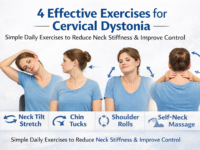
- Gentle neck or limb movements
- Mirror exercises to improve awareness
- Balance and posture alignment
- Breathing techniques to reduce tension
Sometimes, even small adjustments can make a noticeable difference.
The focus is always on quality of movement, not speed or intensity.
Why Small Movements Matter So Much
In dystonia, the brain has learned incorrect movement patterns.
Trying to fix everything at once can overwhelm the system.
That is why physiotherapy often starts small.
A slight correction in posture, a controlled movement repeated carefully, or a relaxation technique practiced daily can begin to shift how the brain responds.
These small steps build over time.
The Role of Consistency
This is where many people struggle.
Physiotherapy is not a one-time solution.
It requires regular practice.
Progress may feel slow at first, and that can be discouraging.
But consistency is what allows the brain to adapt.
Skipping sessions or stopping too early often leads to limited results.
Real Benefits People Experience
When physiotherapy is done correctly and consistently, many people report:
- Improved posture
- Reduced muscle tightness
- Better control over movements
- Less pain
- Increased confidence in daily activities
The changes may not be dramatic overnight, but they can be meaningful over time.
Where Physiotherapy Falls Short
It is important to be honest here.
Physiotherapy does not work the same way for everyone.
Some people experience significant improvement, while others see only mild changes.
In severe cases, physiotherapy alone may not be enough and may need to be combined with other treatments.
This is why expectations need to be realistic.
Combining Physiotherapy with Other Treatments
The best outcomes often come from combining physiotherapy with other approaches.
For example:
- Botulinum toxin injections reduce muscle overactivity
- Medications help balance brain signals
- Physiotherapy retrains movement patterns
Together, these create a more complete treatment plan.
For a broader medical overview of treatment combinations,
https://www.mayoclinic.org/diseases-conditions/dystonia/diagnosis-treatment/drc-20350484
provides reliable insights.
The Hidden Mental Shift That Happens
One of the most powerful effects of physiotherapy is not just physical.
It changes how people feel about their body.
Instead of feeling helpless, patients begin to feel involved in their own recovery.
There is a sense of control that slowly returns.
That shift alone can improve overall well-being.
Can It Prevent Progression?
This is a question many people ask.
Physiotherapy cannot guarantee that dystonia will not progress.
However, it can help manage symptoms more effectively and may slow down the impact on daily life.
Early intervention often leads to better outcomes.
Home Exercises: The Real Game-Changer
What happens outside therapy sessions matters just as much as what happens inside.
Daily practice at home is where real progress builds.
Simple routines, done consistently, reinforce what the brain learns during therapy.
Even 10 to 15 minutes a day can make a difference over time.
Why Some People Give Up Too Early
The biggest challenge with physiotherapy is patience.
Results are not immediate.
In a world where quick solutions are expected, slow improvement can feel frustrating.
But dystonia itself develops over time, and retraining the brain also takes time.
Those who stick with it often see better long-term outcomes.
A Careful Disclaimer
This article is for informational purposes only and should not be considered medical advice. Physiotherapy for dystonia must be guided by qualified professionals based on individual needs and medical history. Always consult a neurologist or physiotherapist before starting any treatment plan.
So, Can Movement Really Retrain Your Brain?
The answer is yes, but not in the way people often expect.
It is not instant. It is not dramatic.
It is gradual, steady, and built on repetition.
Movement, when guided correctly, can help the brain form better patterns.
It may not remove dystonia completely, but it can make life more manageable, more comfortable, and more controlled.
FAQs About Physiotherapy for Dystonia
1. Can physiotherapy cure dystonia?
No, it helps manage symptoms but does not cure the condition.
2. How long does it take to see results?
Some people notice changes in weeks, while others may take months.
3. Is physiotherapy safe for all types of dystonia?
Generally yes, but it should always be guided by a professional.
4. Can I do exercises at home without a therapist?
It is best to learn correct techniques first before practicing at home.
5. Does physiotherapy replace medication?
Not always. It is often used alongside other treatments.
6. Is it worth trying if symptoms are severe?
Yes, but it may need to be part of a combined treatment approach.
Final Thought
Physiotherapy offers something that many treatments do not, a way to actively participate in your own progress. It is not about quick fixes or overnight changes. It is about slowly teaching the body and brain to work together again.
And sometimes, that slow path leads to the most meaningful change.



0 Comments