

















For many people living with dystonia, the first time they hear the word “Botox” in a medical setting, it feels unexpected.
It is often associated with cosmetic treatments, something linked to smoothing wrinkles rather than managing a neurological condition.
But in the world of dystonia, Botox is not about appearance. It is one of the most widely used and effective treatments available, trusted by neurologists and used by thousands of patients every day.
Still, one question remains at the center of it all.
What exactly is happening inside your muscles when Botox is injected?
Understanding that answer changes everything, because it turns a confusing procedure into something clear, logical, and far less intimidating.
The Problem Starts with Overactive Signals
To understand how Botox works, it helps to start with what is going wrong in dystonia.
Your muscles do not move on their own. They respond to signals sent from the brain through nerves.
In a healthy system, these signals are carefully controlled. Muscles contract when needed and relax when the job is done.
In dystonia, this balance is disrupted.
The brain sends signals that are too strong, too frequent, or poorly timed. As a result, certain muscles remain active when they should be resting.
This leads to the twisting, pulling, or repetitive movements that define the condition.
According to the National Institute of Neurological Disorders and Stroke, dystonia is caused by abnormal communication within the brain’s movement control system.
https://www.ninds.nih.gov/health-information/disorders/dystonias
But the effects are felt in the muscles.
Where Botox Steps In
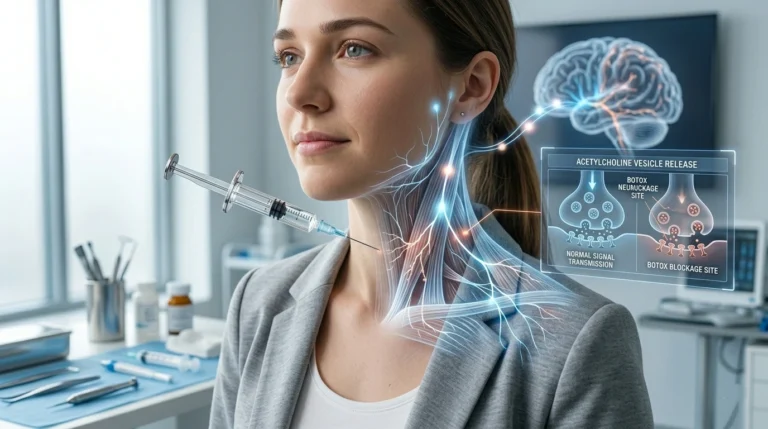
Botox, or botulinum toxin, works at the level where nerves meet muscles.
This connection point is called the neuromuscular junction.
Normally, when a nerve wants a muscle to contract, it releases a chemical called acetylcholine. This chemical acts like a messenger, telling the muscle to activate.
In dystonia, this messaging system becomes overactive.
Botox interrupts that process.
When injected into a specific muscle, it blocks the release of acetylcholine from the nerve endings. Without that signal, the muscle cannot contract as strongly.
The result is a controlled relaxation of the overactive muscle.
It does not paralyze the muscle completely. It simply reduces its ability to overreact.
What Happens Right After the Injection
The effects of Botox are not immediate.
After the injection, the toxin begins to bind to nerve endings, gradually interfering with the release of acetylcholine.
This process takes a few days.
Most people start to notice changes within three to seven days, with full effect developing over one to two weeks.
During this time, the muscle slowly becomes less tense, and abnormal movements begin to ease.
This gradual change is often reassuring, as it allows the body to adjust naturally.
Why the Effects Are Temporary
One of the most common questions is why Botox needs to be repeated.
The answer lies in how the body adapts.
Over time, nerve endings begin to regenerate and form new connections with the muscle.
As these connections recover, the ability to release acetylcholine returns, and the muscle gradually regains its activity.
This is why the effects of Botox typically last around three to four months.
The Mayo Clinic explains that repeated treatments are often necessary to maintain symptom control in dystonia.
https://www.mayoclinic.org/tests-procedures/botox/about/pac-20384658
While this may seem inconvenient, it also means the treatment is adjustable. Doctors can fine-tune doses and target areas over time.
Precision Matters More Than Power
Botox is not about using large amounts of medication. It is about placing it in exactly the right spot.
Each injection is carefully targeted to specific muscles that are causing symptoms.
This precision is what makes the treatment effective.
If the wrong muscle is targeted, the results may be limited or uneven.
This is why experienced specialists often use techniques such as EMG guidance to identify the exact muscles involved.
It is a detailed process, and it plays a major role in the outcome.
What It Feels Like After Treatment
Experiences vary, but many people describe a gradual sense of release in the affected area.
The tightness begins to ease. Movements feel less forced. The body starts to move more naturally.
For some, the change is subtle but meaningful. For others, it is dramatic.
It is not uncommon to feel a difference not just physically, but emotionally as well.
When the body becomes easier to control, confidence often follows.
Possible Side Effects
Like any medical treatment, Botox can have side effects, although they are usually mild and temporary.
These may include:
- Weakness in nearby muscles
- Mild pain at the injection site
- Temporary changes in movement or balance
Serious side effects are rare when the treatment is performed by a qualified professional.
Organizations like the Dystonia Medical Research Foundation emphasize that Botox is considered a safe and effective treatment when administered correctly.
https://dystonia-foundation.org
Understanding these possibilities helps set realistic expectations.
Why Botox Does Not “Fix” the Brain
It is important to understand that Botox does not address the root cause of dystonia in the brain.
The abnormal signals are still being generated.
What Botox does is reduce the impact of those signals on the muscles.
Think of it as lowering the volume of a loud signal rather than stopping it entirely.
This is why Botox is part of a broader treatment approach, often combined with therapy and other interventions.
Who Benefits the Most
Botox is particularly effective for focal dystonia, where symptoms are limited to specific areas such as:
- Neck (cervical dystonia)
- Eyes (blepharospasm)
- Hands (writer’s cramp)
In these cases, targeting individual muscles can lead to significant improvement.
For more widespread forms of dystonia, Botox may still be helpful, but it is often used alongside other treatments.
The Role of Consistency
Botox is not a one-time solution.
Regular treatments allow doctors to refine the approach, adjusting doses and targeting based on how the body responds.
Over time, this can lead to better and more consistent results.
Some patients even find that their symptoms become easier to manage with ongoing treatment.
What Patients Often Wish They Knew Earlier
Many people who benefit from Botox say they wish they had tried it sooner.
The hesitation often comes from misunderstanding, either about what the treatment does or how it works.
Learning that it is a targeted, controlled, and reversible process can make it less intimidating.
And for many, it becomes a key part of regaining control over their movements.
Important Disclaimer
This article is for informational purposes only and should not be considered medical advice. Botox treatment for dystonia should only be administered by a qualified neurologist or healthcare professional after proper evaluation.
FAQs
How does Botox help dystonia?
It blocks nerve signals to overactive muscles, reducing involuntary contractions.
How long does Botox take to work?
Most people notice improvement within a week, with full effects in about two weeks.
How long do the effects last?
Typically three to four months, after which repeat treatment may be needed.
Is Botox safe for long-term use?
Yes, when administered by a trained professional, it is considered safe for ongoing treatment.
Does Botox cure dystonia?
No, it manages symptoms but does not eliminate the underlying neurological cause.
Final Thoughts
Botox may not sound like a neurological treatment at first, but its impact on dystonia is both practical and powerful.
By targeting the exact point where nerves communicate with muscles, it offers a way to reduce the effects of misfiring signals without altering the brain itself.
For many people, that small shift, that quiet reduction in muscle activity, makes a significant difference in daily life.
It is not about changing who you are. It is about giving your body a better chance to move the way it was meant to.



0 Comments