
















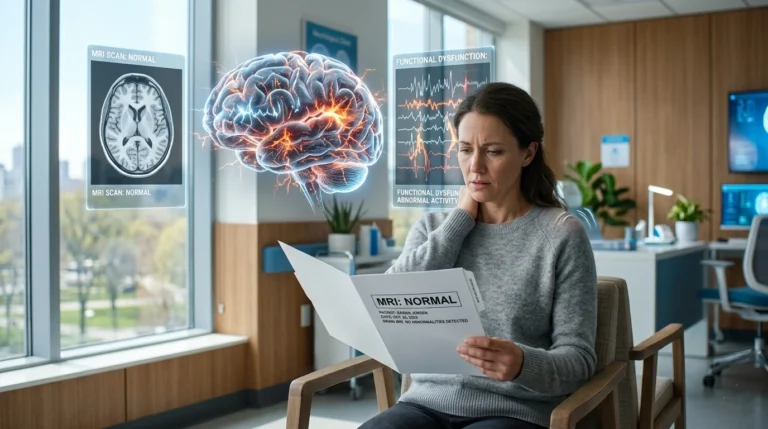
One of the most confusing and often frustrating moments for someone experiencing dystonia symptoms comes inside a doctor’s office, when the scan results come back completely normal, yet the body continues to behave in ways that clearly are not.
You feel it every day, the pulling, the twisting, the loss of control over movements that once felt natural, and yet the report says everything looks fine, and that gap between what you feel and what the test shows can be deeply unsettling.
This is not rare, and it is not imagined, it is one of the defining challenges of dystonia, a condition where the problem is real, visible, and often disruptive, but does not always show up on the tools most people expect to provide answers.
Understanding why this happens is not just important, it is essential, because it explains why so many people spend years searching for a diagnosis that seems just out of reach.
When “Normal” Does Not Mean Healthy
MRI scans are powerful tools, they can reveal tumors, injuries, bleeding, and structural changes in the brain with remarkable clarity, but they are not designed to capture everything.
An MRI shows structure, not function.
This means it can tell you if something in the brain is physically damaged or abnormal in shape, but it cannot fully show how brain signals are working in real time.
Dystonia is not primarily a structural problem, it is a functional one.
The brain looks normal, but the way it sends and processes movement signals is not.
According to the National Institute of Neurological Disorders and Stroke, dystonia involves disruptions in brain circuits that control movement, rather than visible damage that standard imaging can easily detect.
https://www.ninds.nih.gov/health-information/disorders/dystonias
This is why scans often come back clear, even when symptoms are anything but.
The Brain’s Hidden Activity
Every movement you make depends on electrical signals traveling through a network of brain regions, including the basal ganglia, cerebellum, and motor cortex.
These regions must work together with precise timing and coordination.
In dystonia, that coordination breaks down. Signals become distorted, amplified, or poorly timed, leading to involuntary muscle contractions.
But here is the key point, these changes happen at a level that standard MRI scans cannot easily capture.
They are about activity, not anatomy.
It is like having a perfectly built machine with faulty wiring inside. From the outside, everything appears intact, but the system does not function as it should.
Why Doctors Still Rely on MRI
If MRI cannot confirm dystonia, why is it used at all?
The answer is simple.
MRI helps rule out other conditions.
Doctors use it to check for:
- Brain tumors
- Stroke-related damage
- Multiple sclerosis
- Structural abnormalities
By eliminating these possibilities, they narrow down the list of potential causes for the symptoms.
The Mayo Clinic notes that diagnosing dystonia often involves excluding other conditions through imaging and tests, rather than confirming it directly.
https://www.mayoclinic.org/diseases-conditions/dystonia/symptoms-causes/syc-20350480
This process can take time, but it is an important part of reaching the correct diagnosis.
The Emotional Impact of a “Normal” Report
Being told that your scan is normal can feel like a double-edged sword.
On one hand, it is reassuring that there is no visible damage.
On the other, it can feel like your experience is being dismissed.
Some people begin to question themselves. Others are told that their symptoms might be stress-related or psychological.
This is where the journey becomes not just medical, but deeply personal.
The symptoms are real. The challenge is that the tools used to measure them are not always equipped to show them clearly.
The Role of Clinical Observation
Since there is no single test that confirms dystonia, diagnosis relies heavily on clinical observation.
Doctors look at how symptoms appear, how they change with movement, and how the body responds under different conditions.
They may ask questions about:
- When symptoms started
- What triggers them
- Whether they improve with certain actions
This detailed evaluation is often more revealing than any scan.
Movement disorder specialists, in particular, are trained to recognize patterns that are not obvious to others.
Why Symptoms Can Be Inconsistent
Another reason dystonia is difficult to diagnose is that symptoms are not always present.
They may appear during specific tasks and disappear at rest. They may worsen under stress and improve during relaxation.
This variability can make it harder for doctors to observe the condition directly.
It also contributes to the misunderstanding that the symptoms are not consistent or not serious, when in reality, they are simply influenced by how the brain processes signals at different moments.
Advanced Imaging Is Changing the Picture
While standard MRI has limitations, newer technologies are beginning to provide deeper insights.
Functional MRI (fMRI) and other advanced imaging techniques can show how different parts of the brain are active during movement.
These tools have revealed abnormal patterns in brain networks involved in dystonia, even when structural scans appear normal.
Research supported by organizations like the Dystonia Medical Research Foundation continues to explore these findings, bringing us closer to more accurate diagnostic methods.
https://dystonia-foundation.org
Although these techniques are not yet widely used in routine diagnosis, they represent an important step forward.
The Risk of Misdiagnosis
Because MRI results are often normal, dystonia can be mistaken for other conditions.
Some patients are diagnosed with anxiety or functional movement disorders. Others are treated for orthopedic issues that do not fully explain their symptoms.
This misdirection can delay proper treatment and add to the frustration.
Understanding that a normal MRI does not rule out dystonia is crucial for both patients and healthcare providers.
What Patients Can Do
If you are experiencing symptoms that do not match your test results, there are steps you can take to move closer to an answer.
Start by documenting your symptoms in detail, including when they occur and what makes them better or worse.
Recording videos can provide valuable evidence, especially if symptoms are not present during medical visits.
Seeking a neurologist, particularly a movement disorder specialist, can significantly improve the chances of an accurate diagnosis.
Most importantly, trust your experience.
A normal scan does not erase what you feel.
Why Early Recognition Matters
The sooner dystonia is identified, the sooner treatment can begin.
Therapies such as botulinum toxin injections, medications, and physical therapy can help manage symptoms effectively, especially when introduced early.
Delays in diagnosis can allow symptoms to become more established, making them harder to treat over time.
This is why awareness of the limitations of MRI is so important.
It shifts the focus from relying solely on tests to understanding the full clinical picture.
A Condition That Challenges Expectations
Dystonia challenges the way people think about diagnosis.
It does not always show up on scans. It does not follow a simple path. It requires a different kind of attention, one that looks beyond images and focuses on experience.
This does not make it less real. If anything, it highlights how complex the brain truly is.
The absence of visible damage does not mean the absence of a problem.
It simply means the problem exists at a level we are still learning to fully understand.
Important Disclaimer
This article is for informational purposes only and should not be considered medical advice. If you are experiencing unusual or persistent movement symptoms, consult a qualified neurologist or healthcare professional for proper evaluation and diagnosis.
FAQs
Can dystonia show up on an MRI?
In most cases, MRI scans appear normal because dystonia involves functional changes rather than structural damage.
Why do doctors order MRI if it cannot confirm dystonia?
MRI helps rule out other conditions that may cause similar symptoms.
What kind of doctor diagnoses dystonia?
A neurologist, especially a movement disorder specialist, is best suited to diagnose dystonia.
Can symptoms be real if tests are normal?
Yes, dystonia symptoms are real even when standard tests do not show abnormalities.
Does early diagnosis help?
Yes, early treatment can improve symptom management and quality of life.
Final Thoughts
There is a quiet but powerful truth at the center of dystonia.
You can have a normal scan and still have a real condition.
That reality can be difficult to accept, especially in a world that often relies on visible proof, but it is also a reminder that not everything important can be captured in an image.
The brain is more than structure. It is function, connection, and communication.
When those elements go out of balance, the effects can be felt deeply, even if they are not immediately seen.
And as science continues to evolve, the hope is that one day, the gap between what patients feel and what tests reveal will finally begin to close.



0 Comments